
Africa is becoming one of the most important regions for digital commerce, mobile-first financial services and cross-border business growth. With a young population, fast-growing smartphone adoption and strong demand for digital services, African markets offer significant opportunities for global merchants.
However, succeeding in Africa requires more than enabling a basic card checkout. Across many markets, customers rely on mobile money, local wallets, bank transfers, local cards and other familiar payment methods. For businesses expanding into Kenya, Nigeria, Ghana, South Africa, Egypt and other African markets, a localised payment experience can be the difference between a completed transaction and an abandoned checkout.
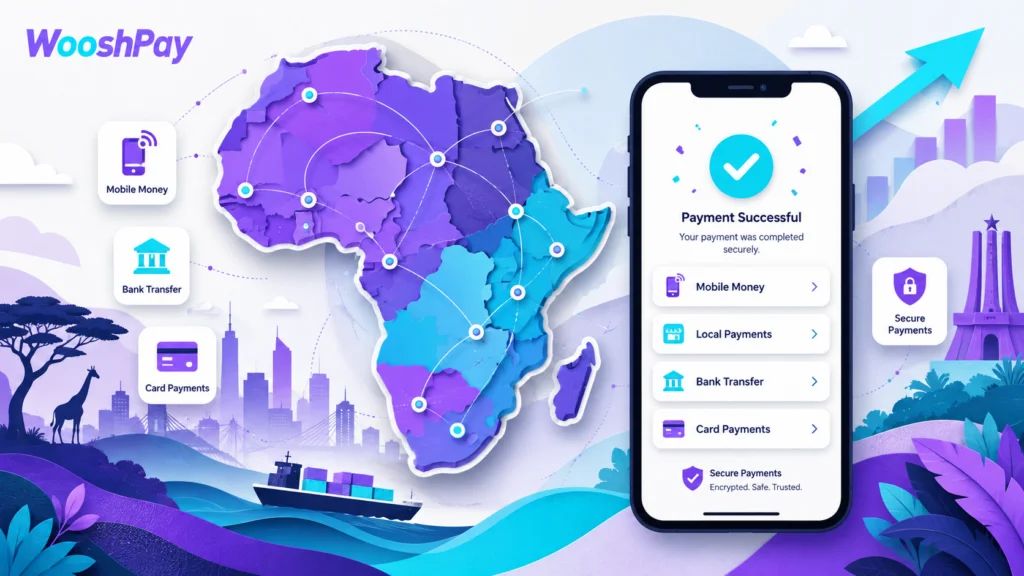
WooshPay’s Africa payment solution helps global merchants build a more flexible payment experience for local customers while simplifying multi-market payment operations through one unified platform.
Why Africa Requires a Localised Payment Strategy
Africa is not a single payment market. Payment behaviour can vary significantly between countries, regions, customer groups and business models. A payment method that works well in Kenya may not be the preferred option in Nigeria. A customer in Ghana may expect different payment options from a customer in South Africa or Egypt.
This diversity makes localisation essential. Merchants entering African markets need to understand how customers prefer to pay, which payment methods they trust and what kind of checkout experience feels familiar.
A localised checkout can help businesses reduce payment friction, improve customer confidence and reach more users. Instead of forcing every customer into one global payment flow, merchants can provide payment options that better match local habits.
Why Mobile Money Matters in African Digital Commerce
Mobile money is one of the most important payment trends in Africa. In many markets, mobile money has helped customers access digital financial services even when traditional banking access is limited. For online businesses, this creates a major opportunity to serve users who may prefer wallet-based or mobile-first payment experiences over standard card payments.
Mobile money is especially relevant for digital commerce, online services, gaming, travel, education, subscriptions, creator platforms and marketplaces. These businesses often need payment methods that are fast, familiar and easy to use on mobile devices.
For global merchants, mobile money is not just another payment method. It is part of the customer experience. Supporting local payment preferences can help businesses build trust and improve conversion in African markets.
Key Payment Trends Across African Markets
Africa’s payment landscape is highly diverse. Each market has its own payment infrastructure, consumer preferences and regulatory environment.
In Kenya, mobile money has played a major role in shaping digital payment behaviour. In Nigeria, customers may use a mix of cards, bank transfers, wallets and local payment options. In Ghana and other West African markets, mobile money and wallet-based payments are important parts of the digital payment ecosystem. In South Africa, cards, bank payments and digital wallets can all be relevant depending on the customer segment. In Egypt, digital wallets, cards and bank-linked payment experiences continue to develop as online commerce grows.
These examples show why businesses should not treat Africa as one uniform payment market. A stronger strategy is to use a flexible payment platform that can adapt to local payment preferences market by market.
Support Cards, Mobile Money, Bank Transfers and Local Payment Methods
A practical Africa payment solution should support both global and local payment preferences. Depending on merchant onboarding, business type and channel availability, merchants may need to offer a mix of cards, mobile money, mobile wallets, bank transfers, local cards and other local payment methods.
This flexibility is important because different businesses often require different payment journeys. An e-commerce merchant may need a broad range of payment options at checkout. A digital goods platform may need fast mobile payments. A SaaS business may need recurring payment support. A marketplace may need payment options that work for both buyers and sellers across multiple countries.
WooshPay helps merchants build payment experiences that are easier to adapt across different African markets while keeping payment operations manageable through one platform.
How WooshPay Helps Merchants Simplify Africa Payments
Entering Africa can create operational complexity. Merchants may need to manage multiple payment methods, currencies, payment statuses, refunds, transaction reporting and reconciliation across several markets.
WooshPay helps reduce this complexity through a unified payment platform. Instead of managing fragmented payment connections market by market, merchants can use WooshPay to centralise payment operations and support a more localised checkout experience.
WooshPay can help businesses:
- Build localised checkout experiences for African customers
- Support global and local payment preferences
- Manage multiple payment methods through one platform
- Improve payment continuity with routing capabilities
- Simplify transaction reporting and reconciliation
- Support cross-border payment operations
- Prepare for long-term multi-market growth
For merchants expanding across Africa, this combination of local flexibility and centralised management can help reduce operational burden and support scalable growth.
Built for Cross-Border and Digital Businesses
Africa offers strong opportunities for many types of online businesses. Cross-border e-commerce, digital goods, SaaS, subscriptions, gaming, online education, travel, marketplaces and creator economy platforms can all benefit from a more localised payment strategy.
These businesses often face similar challenges. They need to serve customers across different countries. They need to offer payment methods that customers recognise. They need to monitor transaction performance. They also need to manage payment data, refunds and reconciliation without creating unnecessary operational complexity.
WooshPay is designed for businesses that want to grow across markets while keeping payment management efficient and scalable.
Improve Conversion with Localised Checkout
Checkout experience has a direct impact on revenue. Even if a customer is ready to buy, they may abandon the purchase if the available payment options feel unfamiliar or inconvenient.
A localised checkout helps solve this problem by offering payment methods that customers already know and trust. In African markets, this may include mobile money, bank transfers, cards, wallets or other local payment methods, depending on the country and customer segment.
The goal is not to offer every possible payment method everywhere. The goal is to offer the right payment experience for the right market. With a more relevant checkout flow, merchants can reduce friction and give customers greater confidence to complete payments.
Why Choose WooshPay for Africa?
WooshPay combines payment flexibility, local payment adaptation and unified payment management. For global merchants entering Africa, this creates a practical foundation for growth.
With WooshPay, businesses can move beyond a one-size-fits-all checkout model and build payment experiences that better match local expectations. At the same time, merchants can keep payment operations centralised, visible and easier to manage.
This is especially valuable for businesses expanding into multiple African markets, where payment fragmentation can otherwise increase technical and operational costs.
Conclusion
Africa is a high-potential region for digital commerce, but payment success depends on localisation. Mobile money, local wallets, bank transfers, cards and local payment methods all play important roles in how customers pay across different African markets.
For global merchants, the challenge is to support local payment preferences while keeping operations simple, scalable and reliable.
WooshPay’s Africa payment solution helps businesses build localised checkout experiences, manage multiple payment methods and simplify cross-border payment operations through one unified platform.
For merchants expanding into Kenya, Nigeria, Ghana, South Africa, Egypt and other African markets, WooshPay provides a practical payment foundation for mobile-first commerce and multi-market growth.
FAQ
What is an Africa payment solution?
An Africa payment solution helps merchants accept payments from customers across African markets through payment methods and checkout flows that better match local payment behaviour.
Why is mobile money important in Africa?
Mobile money is important because many customers in African markets use mobile-first financial services for everyday payments. Supporting mobile money can help merchants reach more customers and provide a more familiar checkout experience.
Why do merchants need local payment methods in Africa?
Local payment methods can help reduce checkout friction, improve customer trust and support payment preferences that vary across African markets.
How can global merchants accept payments in Africa?
Global merchants can use a unified payment platform that supports localised checkout, multiple payment methods, transaction management, reconciliation and cross-border payment operations.
Is WooshPay suitable for businesses expanding into Africa?
Yes. WooshPay is suitable for cross-border e-commerce, SaaS, subscriptions, digital goods, gaming, education, travel, marketplaces and other businesses expanding into African markets.
How does localised checkout improve payment conversion?
Localised checkout improves conversion by offering customers payment options they recognise, reducing unnecessary friction and making the payment experience feel more familiar and trustworthy.