
Introduction: In Cross-Border Trade, the Biggest Cost Isn’t the Fee, It’s the “Uncertainty”
For any global business, completing a cross-border transaction is never as simple as just “sending money from point A to point B.” It’s a long journey that traverses multiple financial intermediaries, spans different time zones, and endures the volatility of foreign exchange rates.
We are accustomed to calculating the “visible” costs: bank wire fees, a payment gateway’s percentage commission. But what truly erodes our profits are the “invisible” costs:
- The Cost of Time: Funds that are in transit for 3-5 business days represent tied-up cash flow, which is a cost in itself.
- The Cost of FX Risk: The currency fluctuation over several days, from the moment of transaction to the moment funds arrive, can easily wipe out an already thin profit margin.
- The Cost of Trust: When dealing with a new customer or supplier, how do you ensure “payment on delivery” or “shipment after payment”? Traditional tools like Letters of Credit (L/C) are cumbersome and expensive.
- The Cost of Failure: A payment failure or rejection due to an intermediary bank’s information error or a compliance issue not only incurs extra fees but also damages business reputation.
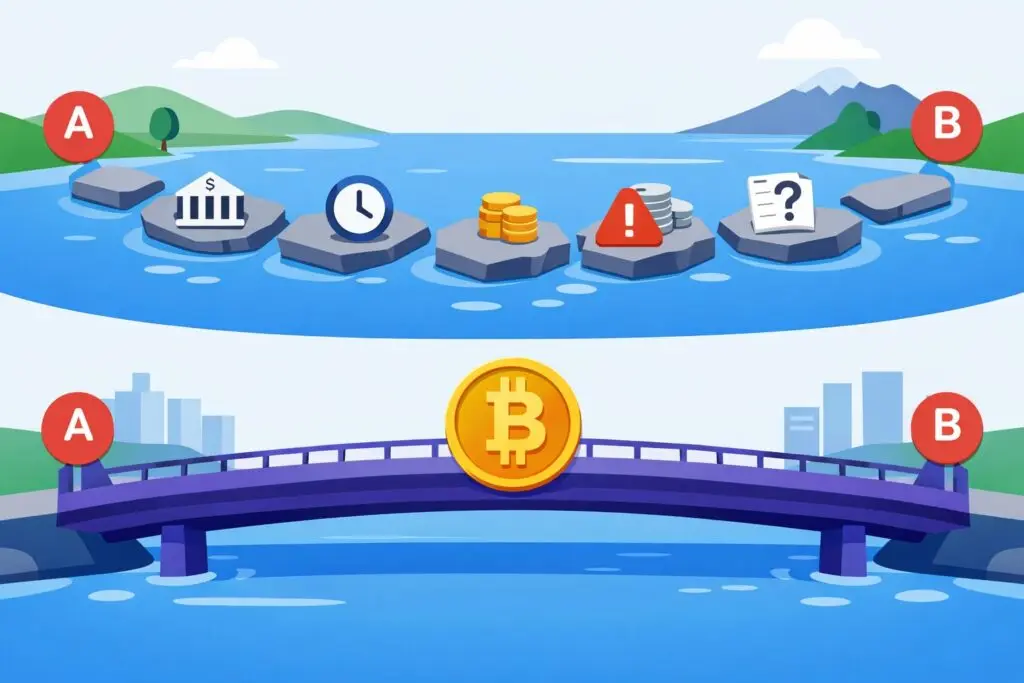
The traditional payment system is like a long chain made of many fragile links. Cryptocurrency payments (especially stablecoins) offer a fundamentally new solution: they don’t just optimize this chain; they replace it entirely with a shorter, stronger “digital contract.”
The “Trust and Efficiency” Dilemma of Traditional Cross-Border Payments
Let’s trace a typical international trade payment:
- Initiation: The importer (payer) submits a payment instruction to their local bank.
- Transit: The payer’s bank sends the instruction via the SWIFT network to one or more “correspondent banks” (intermediaries).
- Waiting & Conversion: The funds “travel” between these intermediary banks, with each step potentially adding delays and fees. If currency conversion is involved, the exchange rate is often unfavorable.
- Arrival: Finally, the funds reach the exporter’s (payee’s) local bank.
- Crediting: After a compliance check, the payee’s bank credits the funds to the exporter’s account.
Every “arrow” in this process is a potential point of risk and a point of cost. When the two parties don’t trust each other, we need to introduce the even more complex Letter of Credit (L/C) process, using banks as credit intermediaries, which further increases the cost in both time and money.
How Crypto Payments Emerge as a “Risk Solution”
Cryptocurrency payments, particularly stablecoins (like USDT, USDC) that are pegged 1:1 to fiat currencies like the US dollar, offer a disruptive solution. They compress the long chain described above into a near-instant, peer-to-peer value transfer.
- Solving “Time & FX Risk”: Near-Real-Time Global Settlement A stablecoin payment from one side of the globe to the other typically takes a few minutes, not a few days. This means:
- Cash flow is massively liberated: You no longer need to be anxious about funds in transit.
- FX risk is eliminated: The value at the time of the transaction is the value you receive. You can choose to convert the stablecoins into your local fiat currency at the most favorable exchange rate after receiving them.
- Solving “Trust Risk”: Smart Contracts Where Code is Law Blockchain-based smart contracts can create an “automated escrow and settlement” system that requires no third-party intermediary.
- Example: Automated “Payment on Delivery”
- The buyer locks the payment (in stablecoins) into a smart contract.
- The seller ships the goods and uploads the tracking number to the contract.
- The smart contract automatically queries the logistics system via an API. Once it confirms “goods have been delivered,” the contract automatically releases the funds to the seller.
- The entire process is executed automatically by code, is transparent, and cannot be tampered with by anyone. It perfectly solves the trust problem between the two parties at a fraction of the cost of a traditional L/C.
- Example: Automated “Payment on Delivery”
- Solving “Failure & Operational Risk”: A Simpler, More Transparent Path A crypto payment requires only a “wallet address,” not a long string of complex bank account information, SWIFT codes, and addresses. This dramatically reduces the risk of payment failure due to human error. The path of every transaction is publicly verifiable on the blockchain, completely eliminating the “black box” status of “where are my funds?”
WooshPay’s Role: Helping You Harness the Power of Crypto Safely and Easily
Despite the immense advantages of crypto payments, the complexity of direct operation, the risks of private key management, and regulatory uncertainty deter many businesses. WooshPay’s role is to build a safe, compliant bridge for you to the world of cryptocurrency.
- A Simple Fiat Experience: Your customers can pay using their familiar local payment methods, while you can choose to receive the funds in the form of stablecoins, and vice versa. We handle all the complex conversion processes.
- Worry-Free Wallet Management: WooshPay provides an enterprise-grade secure wallet infrastructure, managing private keys and wallet security for you. This allows you to enjoy the benefits of crypto without needing to be a cryptography expert.
- A Clear Compliance Path: We partner with licensed institutions in major global markets to ensure that every crypto transaction you make meets local regulatory requirements, giving you complete peace of mind.
Conclusion: It’s Time to Add Crypto to Your Financial Toolbox
In 2026, viewing cryptocurrency payments as merely a “trendy payment method” is strategically short-sighted.
A more accurate perspective is to see it as a powerful financial risk management tool. It can effectively hedge against the inherent time, exchange rate, trust, and operational risks of the traditional cross-border payment system, directly protecting and boosting your global business profits.
Choosing a professional payment infrastructure partner like WooshPay means you can safely, compliantly, and easily put this advanced tool to work for you, building a strong “moat” for your globalized business.