
Introduction: Does Your Payment System Have a “Brain”?
For the past decade, when we talked about payment technology, we focused on the “pipes”—faster processing speeds, more payment channels, lower fees. We were dedicated to building bigger and more numerous “funding pipes.” However, a complex system composed of countless pipes, without an intelligent “central brain” to direct them, will ultimately lead to chaos and inefficiency.
This is the fundamental revolution AI Agents bring to the payments domain: it’s no longer about optimizing the “pipes,” but about installing a “brain” with the ability to think, plan, and act autonomously on top of all the pipes.
How does this “brain” work? How does it transform a simple payment request into a complex, self-optimizing task that spans multiple functional modules? The “AI Agent Payments: Layered Architecture” diagram above reveals the inner workings of this next-generation payment engine.
This article will use this architectural diagram as a blueprint to dissect, layer by layer, how a truly AI Agent-driven payment system can bring disruptive value to your business.
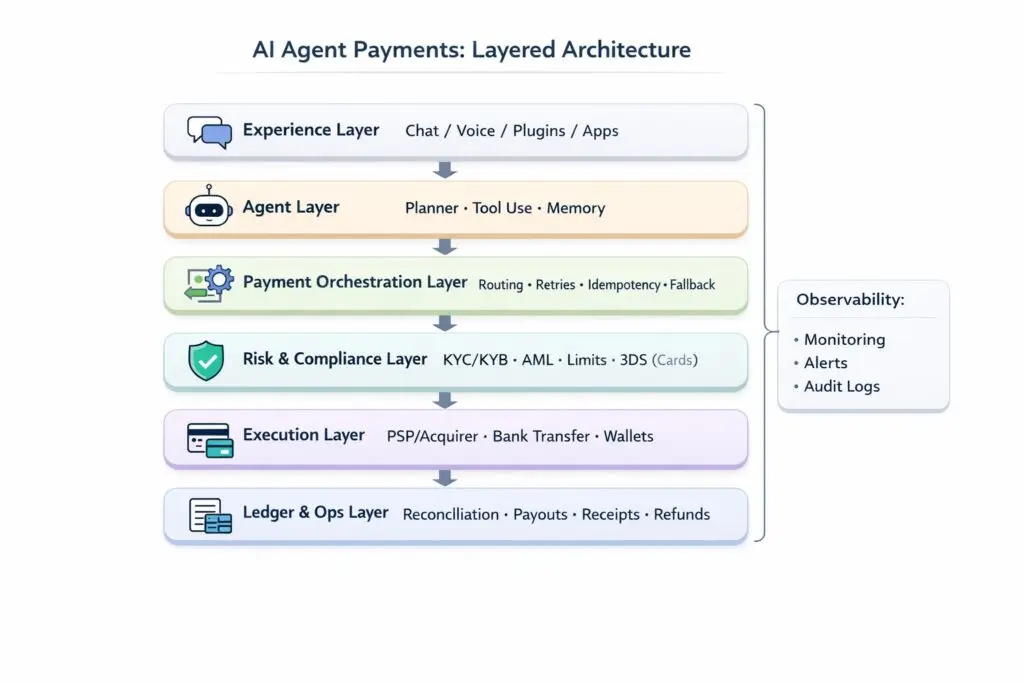
Decoding the Architecture: A Top-Down “Intelligent Decision Chain”
As the architecture diagram shows, an AI Agent payment process is no longer a simple “request-response” but a top-down, progressive chain of intelligent decisions.
- Experience Layer – The Starting Point of Intent It all begins with the user’s “intent.” Whether a user says to a chatbot, “Help me pay last month’s bill,” or clicks “Buy” within an app, this layer is responsible for capturing the user’s original request and passing it to the system’s brain.
- Agent Layer – The Core of Thinking and Planning This is the “brain” of the entire architecture. When it receives an “intent” from the Experience Layer, it does three critical things:
- Planner: It breaks down a vague goal (e.g., “pay the bill”) into a series of clear, executable steps (e.g., 1. Query bill amount; 2. Select optimal payment method; 3. Execute payment; 4. Update bill status).
- Tool Use: Like a skilled craftsman, it calls upon all the lower-level modules (such as routing, risk, settlement, etc.) as its “toolbox” to complete each planned step.
- Memory: It remembers the context and outcome of the task to optimize future decisions. For example, if a payment fails through a certain channel, it will “remember” this and prioritize other channels in similar future situations.
How the Agent Drives an “Autonomous” Payment Engine
Once the AI Agent has a plan, it begins to direct the “functional modules” below to work in concert, collectively forming a powerful and autonomous payment engine.
- Payment Orchestration Layer – Intelligent Routing The Agent’s first command is often “find the best path.” This layer acts as an intelligent “air traffic control center.” Based on real-time data, it automatically selects the payment channel with the highest success rate and lowest cost, and in milliseconds, switches to a backup channel (Fallback) when the primary one is unstable, ensuring transactions flow smoothly.
- Risk & Compliance Layer – The Security Guard Before executing the payment, the Agent calls the risk module for a “security check.” This layer automatically performs a series of compliance actions like KYC/KYB verification, Anti-Money Laundering (AML) screening, and 3DS authentication. Based on AI models, it conducts real-time risk assessments for every transaction, accurately intercepting fraud while minimizing false positives on legitimate users.
- Execution Layer – The Action Unit After passing the “security check,” the payment instruction arrives at the Execution Layer. This layer is the “hands and feet” that actually interact with the external financial world. It completes the final fund transfer through specific Payment Service Providers (PSPs), bank transfer interfaces, or e-wallets.
- Ledger & Ops Layer – Recording and Post-Processing After the payment is complete, the Agent’s job isn’t over. It directs the Ledger Layer to accurately record the transaction, handle potential Payouts and Reconciliation, and generate Receipts, preparing for future operational tasks like Refunds.
Global Observability:
It’s worth noting that every layer, from Orchestration to Ops, is covered by a global Observability module (including Monitoring, Alerts, Audit Logs). This provides continuous feedback data to the AI Agent, allowing it to “see” the results of its decisions and constantly learn and evolve.
WooshPay’s Role: Turning This Advanced Architecture into Your Plug-and-Play Tool
Looking at this, you might think this architecture is incredibly powerful, but also incredibly complex. You are absolutely right. Building such a system from scratch requires a massive technical investment.
And WooshPay’s core mission is to transform this advanced “AI Agent Payment Architecture” into a standardized service that you can easily plug and play.
We have already done all the complex underlying work for you—from building a powerful Agent brain to integrating and optimizing every functional module. When you choose WooshPay, you’re not just getting a simple payment API; you’re getting this entire advanced payment engine that can think for itself, optimize itself, and continuously create value for your business.
Conclusion: Choose the Next-Gen Architecture to Win the Next Decade
The future of payment technology is no longer about connecting more “pipes”; it’s about having a smarter “brain.”
An AI Agent-driven payment architecture can elevate your financial operational efficiency, risk control capabilities, and business resilience to a whole new level. It liberates your team from tedious, reactive daily tasks, allowing them to focus on more strategic and innovative work.
Choosing WooshPay means choosing to arm today’s business with the architecture of tomorrow, laying a solid foundation for you to compete and win in the next decade.