
AI Agent Payments: The Next Step in Online Checkout
AI agent payments are changing how consumers discover, decide, and pay online. As agentic commerce grows, shoppers may no longer move through a traditional journey of searching, comparing, adding to cart, and checking out manually. Instead, AI shopping agents can help users find products, compare options, manage checkout, and complete purchases through a conversational or automated experience.
For merchants, this shift creates a new question: is your payment infrastructure ready for AI-driven checkout?
Agentic commerce is still developing, but the direction is clear. OpenAI’s Instant Checkout has already shown how AI interfaces can move from product discovery to purchase completion, while keeping merchants responsible for orders, payments, fulfillment, returns, and customer support. Stripe’s agentic commerce documentation also describes agents as intermediaries that can help buyers make purchase decisions, manage carts and checkout, and accept payments.
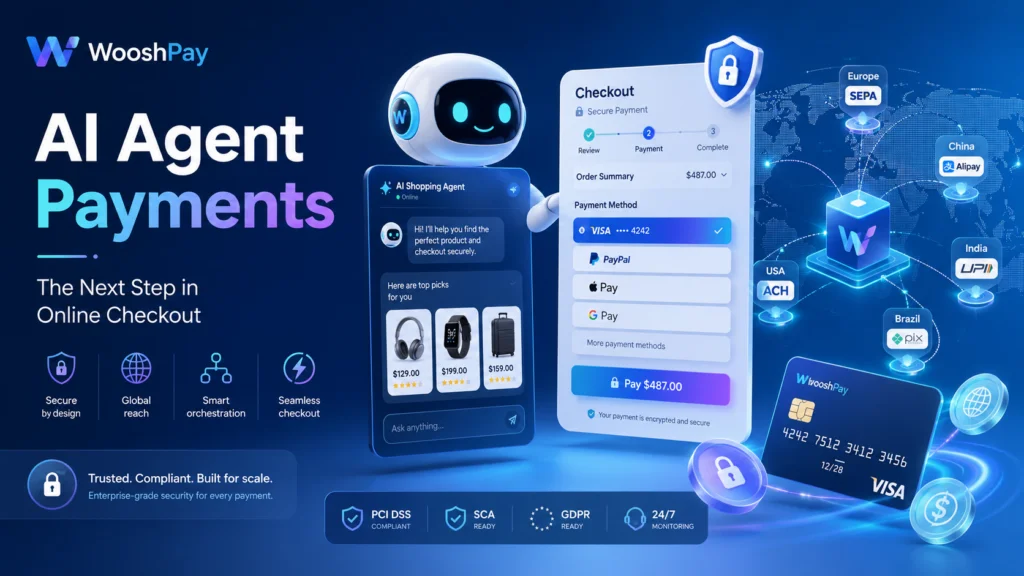
For businesses selling across borders, this new era will require more than a standard payment page. Merchants will need secure AI payments, localized payment methods, flexible payment orchestration, fraud controls, and a checkout experience that can work across channels. WooshPay helps businesses prepare for this shift with global payment gateway capabilities designed for modern cross-border commerce.
What Are AI Agent Payments?
AI agent payments refer to transactions where an AI agent assists, initiates, or helps complete a payment on behalf of a user. In a traditional checkout flow, the customer manually browses a website, selects a product, enters payment details, and confirms the order. In an AI checkout flow, the user may ask an AI assistant to find the best product, compare prices, apply preferences, and move toward purchase with minimal friction.
This does not mean users lose control. In a secure agentic payment model, the user should still confirm key actions, payment details should be protected, and the merchant should receive only the information required to complete the transaction. OpenAI describes trust as a core part of agentic commerce, including user confirmation, secure payment tokens, and minimal data sharing.
In simple terms, AI agent payments connect three parties:
- The user, who gives intent and approval
- The AI agent, which helps interpret the user’s request and coordinate checkout
- The merchant, who processes the order, payment, fulfillment, and support
This makes payments a critical layer in agentic commerce. If the payment experience is slow, limited, or unsafe, the whole AI shopping journey breaks down.
Why Agentic Commerce Matters for Merchants
Agentic commerce matters because AI may become a new front door to online shopping. Instead of starting every purchase on a search engine, marketplace, or merchant website, customers may begin inside an AI assistant. They may ask for “the best running shoes under $100,” “a travel plan for Tokyo,” or “a monthly subscription tool for my team,” and expect the AI agent to narrow the choices and help them buy.
This changes the role of checkout. The checkout experience must be ready for faster decision-making, richer context, and new types of transaction flows. Merchants will need to make sure their product, pricing, payment, and fulfillment systems can interact with AI-driven channels.
Visa has described agentic commerce as a shift where AI agents can deliver personalized recommendations and make secure purchases on behalf of users, supported by tokenization, authentication, user consent, and fraud management. That means payment providers, gateways, and merchants will all play an important role in building trust.
For merchants, the opportunity is significant:
- Reach users earlier in the shopping journey
- Reduce checkout friction
- Support personalized and contextual buying experiences
- Improve conversion through localized payment methods
- Build trust with secure and transparent payment flows
The merchants that prepare early will be better positioned when AI shopping agents become a mainstream sales channel.
Key Payment Challenges in AI Agent Transactions
AI agent payments introduce new opportunities, but they also create new payment challenges.
- User Consent and Authentication
AI agents should not make payments without clear user permission. A secure AI payment flow needs explicit confirmation, authentication, and clear transaction details before money moves. This is especially important for high-value purchases, subscriptions, travel bookings, and repeat payments.
- Payment Tokenization
Tokenization is central to secure AI payments. Instead of exposing raw card or account details, tokenized credentials can allow agents and merchants to complete approved transactions while reducing data exposure. The Agentic Commerce Protocol also highlights secure sharing of payment credentials as part of a common language for agentic commerce.
- Fraud and Bot Risk
As AI agents become part of online transactions, merchants will need stronger fraud controls. Payment systems must distinguish between legitimate AI-assisted purchases and suspicious automated activity. This requires transaction monitoring, risk signals, authentication, and dispute management.
- Local Payment Preferences
Agentic commerce will not be global by default unless payment methods are local. A shopper in Brazil may prefer PIX. A customer in Mexico may prefer SPEI or OXXO. A buyer in South Korea may expect Kakao Pay or Naver Pay. If an AI agent recommends a product but the checkout does not support the user’s preferred payment method, conversion can still fail.
- Post-Purchase Support
AI-driven checkout does not remove the merchant’s responsibilities. Merchants still need to handle fulfillment, refunds, disputes, delivery issues, and customer support. OpenAI’s Instant Checkout model also emphasizes that merchants continue to handle payments, fulfillment, and customer relationships through their existing systems.
How WooshPay Helps Businesses Become AI-Ready
WooshPay helps merchants build payment infrastructure that can support the next generation of online checkout. While AI agent payments are still emerging, the foundation is already familiar: businesses need reliable payment acceptance, localized checkout, secure processing, and flexible payment operations.
Localized Payment Methods for Agentic Commerce
AI shopping agents may help customers discover products, but localized payment methods help customers complete purchases. WooshPay supports merchants in reaching customers across markets by enabling access to local and alternative payment methods, helping businesses reduce checkout friction and better match local payment preferences.
For cross-border merchants, this is especially important. Local payment options can improve trust, reduce cart abandonment, and make the checkout experience feel familiar to customers in different regions.
Payment Orchestration for AI-Driven Checkout
As AI checkout evolves, merchants may need to route transactions across different payment methods, regions, currencies, and processors. Payment orchestration helps businesses manage these complexities through a more unified payment layer.
With a flexible payment gateway, merchants can better prepare for new transaction flows, including AI-assisted checkout, subscriptions, digital goods, travel bookings, and in-app purchases.
Secure Payment Infrastructure
Security will define whether customers trust AI agent payments. WooshPay focuses on secure payment processing, fraud prevention, and reliable transaction handling, helping merchants protect both their business and their customers.
In an AI-driven environment, secure payments are not only about protecting card data. They are also about transaction transparency, authentication, monitoring, and the ability to respond quickly when something goes wrong.
Cross-Border Payment Readiness
Agentic commerce will likely be global. AI agents can recommend products and services from merchants across different countries, but payment acceptance remains local, regulated, and complex. WooshPay helps merchants simplify cross-border payment operations by supporting localized payment acceptance, currency-related needs, and market-specific payment experiences.
For businesses expanding into new regions, this can make AI-driven demand easier to capture.
Use Cases for AI Agent Payments
AI agent payments may first become common in industries where users already rely on recommendations, comparison, and fast digital checkout.
电子商务
AI shopping agents can help users compare products, check availability, and complete purchases. Merchants with localized payment methods and smooth checkout flows will be better positioned to convert this traffic.
Travel
Travel is a natural fit for agentic commerce. AI agents can compare flights, hotels, activities, and travel packages. Visa also lists travel planning as one of the real-world applications for agentic commerce.
Digital Goods and Subscriptions
For SaaS, online education, gaming, streaming, and digital content, AI agents may help users choose plans, manage subscriptions, or purchase add-ons.
B2B Procurement
In the future, AI agents may help businesses source suppliers, compare quotes, reorder inventory, and pay invoices. Visa’s AI commerce materials also describe business scenarios such as low-inventory detection, supplier sourcing, payment, and reconciliation.
How Merchants Can Prepare for Agentic Commerce
Merchants do not need to wait for agentic commerce to become fully mature. They can start preparing now by improving the payment foundations that AI agent payments will depend on.
First, review your current checkout experience. Make sure it is fast, mobile-friendly, and easy to complete.
Second, expand local payment methods in your target markets. AI may bring customers to your checkout, but local payment options will help them complete the purchase.
Third, strengthen fraud prevention, authentication, and transaction monitoring. AI-driven commerce will require stronger trust signals and clearer risk controls.
Fourth, prepare your APIs and payment operations for more flexible transaction flows. AI checkout may not always look like a standard website checkout.
Finally, keep ownership of the customer relationship. Even when an AI agent assists with the purchase, merchants still need to manage fulfillment, refunds, disputes, support, and long-term customer engagement.
The Future of AI Agent Payments
AI agent payments are not just a new checkout feature. They represent a broader shift in how people interact with online commerce. As AI agents become more capable, they may become a major interface for product discovery, decision-making, and payment.
For merchants, the winners will be those that combine AI visibility with payment readiness. A business may be recommended by an AI agent, but conversion still depends on whether the customer can pay securely, locally, and conveniently.
WooshPay helps merchants prepare for this future with payment infrastructure built for cross-border commerce, localized payment acceptance, and secure digital transactions.
结论
Agentic commerce is moving payments into a new era. AI agents may change how customers search, compare, and buy, but the fundamentals of successful payment acceptance remain the same: trust, localization, security, flexibility, and reliability.
With WooshPay, businesses can build a stronger payment foundation for AI-driven checkout and prepare for the next generation of online commerce.
Prepare your business for AI agent payments with WooshPay’s global payment 网关, localized payment methods, and secure payment infrastructure.
FAQs About AI Agent Payments
What are AI agent payments?
AI agent payments are transactions where an AI agent helps a user complete a purchase. The AI agent may assist with product discovery, comparison, checkout coordination, and payment confirmation.
What is agentic commerce?
Agentic commerce is a new model of online commerce where AI agents help users discover, decide, and buy products or services through AI-powered interfaces.
Are AI agent payments safe?
AI agent payments can be safe when they include user consent, authentication, tokenized payment credentials, fraud monitoring, and clear post-purchase support.
How can merchants prepare for agentic commerce?
Merchants can prepare by improving checkout speed, adding localized payment methods, strengthening fraud controls, preparing APIs, and choosing a flexible payment gateway.
How does WooshPay help with AI-ready payments?
WooshPay helps merchants build AI-ready payment experiences through localized payment acceptance, cross-border payment support, secure processing, and flexible payment infrastructure.