
Introduction: The “Black Box” of Cards: Why Does One Card Work While Another Fails?
In managing global online expenditures, virtual cards have become an indispensable tool. Yet, all users face a common puzzle: Why do some virtual cards work flawlessly on certain websites, while others are repeatedly declined? Why can a card used for ad spend not be used for a SaaS subscription?
The answers to these questions are hidden within the design of the card itself. Every virtual card is not just a simple “string of digits,” but a highly sophisticated product defined by its issuer, card network, numbering rules, and security mechanisms.
To truly boost payment success rates, we must stop treating the card as a “black box.” Instead, like a precision engineer, we need to delve into its inner workings to understand its structure and operating principles. This article will deconstruct every key element of a virtual card for you, revealing the underlying secrets that determine payment success or failure.
The “Identity DNA” of a Virtual Card: More Than Just a Number
When you receive a virtual card, you see a card number, an expiration date, and a security code. But behind this string of digits lies the “Identity DNA” that determines its fate.
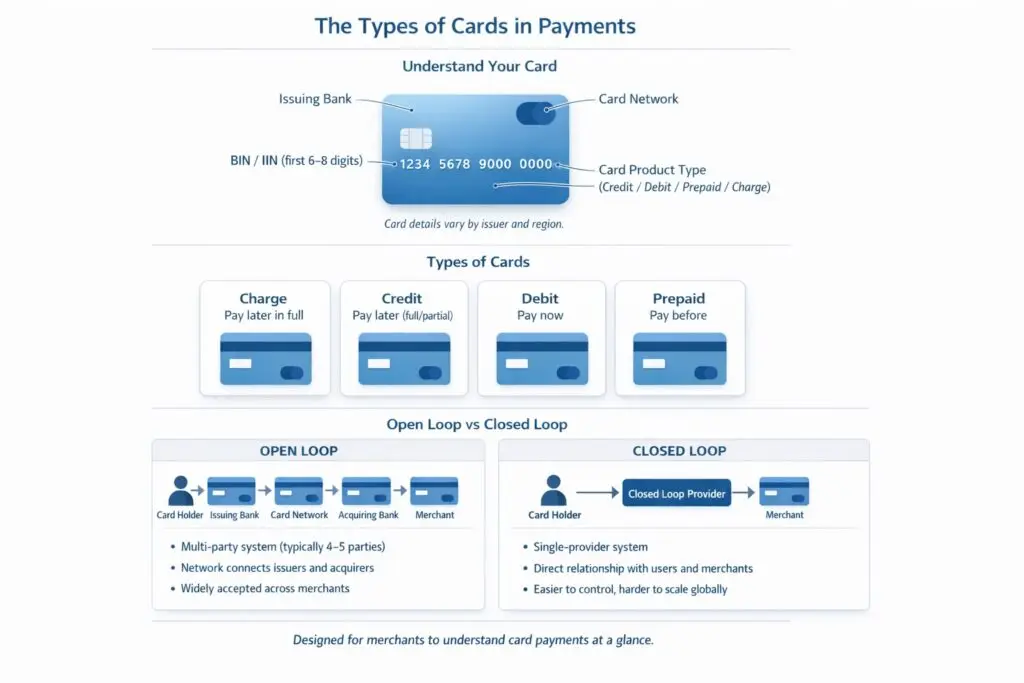
As the diagram above illustrates, a card’s “Identity DNA” is primarily composed of the following parts:
- Bank/Issuer Identification Number (BIN/IIN): These are the first 6-8 digits of the card number and serve as the card’s most important “ID number.” It directly tells payment systems worldwide:
- “Who I am”: Which bank or financial institution (Issuer) issued this card?
- “Where I’m from”: In which country is the issuer located?
- “What I can do”: Is this a charge, credit, debit, or prepaid card? Is it a personal or commercial card? Many online merchants’ risk systems set “acceptance rules” based directly on the BIN. For example, a North American merchant might decline payment attempts from BINs originating in certain high-risk countries.
- Card Network: The first digit of the card number often indicates its network, such as Visa or Mastercard. These networks are the “superhighway systems” connecting issuers and acquirers globally. They operate in two models:
- Open-Loop Network: Like Visa/Mastercard, they do not issue cards themselves but establish the network and rules that connect thousands of member banks. This is the dominant model for global acceptance.
- Closed-Loop Network: Like early American Express, the company acts as the issuer, acquirer, and network, forming a self-contained ecosystem.
- Card Type: The card type information embedded in the BIN directly dictates its payment logic. For instance, a Prepaid card requires funds to be loaded before use, while a Credit card has a credit limit. Some merchants may decline prepaid cards due to risk or cost considerations.
Therefore, when your virtual card payment fails, the first question to ask is: Does this card’s “Identity DNA” (its issuer, origin, card type) meet the “entry requirements” of the receiving merchant?
The “Security Passwords” of a Transaction: CVV1, CVV2, and EMV Cryptograms
If your card passes the “identity” check, it next faces the second hurdle: security validation. To confirm that the transaction is genuinely initiated by you, the payment system requires different “security passwords” depending on the transaction scenario.
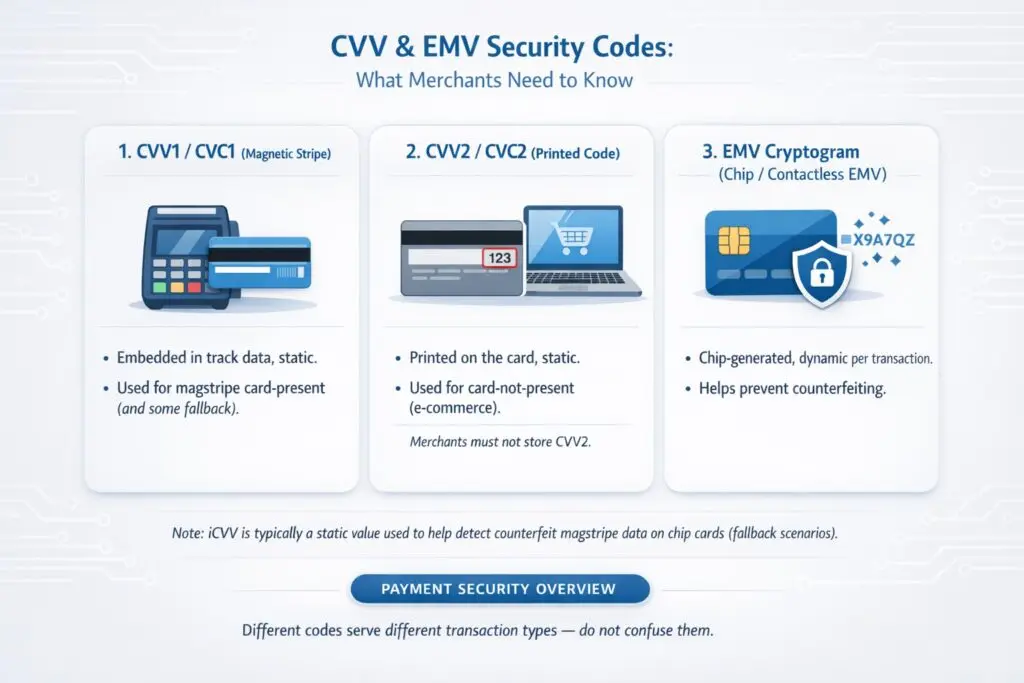
- CVV1 (Magnetic Stripe Code): This security code is encoded on the magnetic stripe of a physical card and is used for verification during offline swipes. In the world of virtual cards, we almost never encounter it.
- CVV2 (Online Transaction Code): This is the familiar 3-4 digit security code printed on the back of a physical card or provided with virtual card details. It is the core verification method for all online “Card-Not-Present” (CNP) transactions. If the CVV2 is entered incorrectly, the transaction will be declined outright.
- EMV Dynamic Cryptogram (Chip/Contactless Code): When you use a chip card (insertion) or NFC (tap-to-pay), the chip inside the card performs a complex cryptographic calculation with the POS terminal to generate a one-time, dynamic transaction cryptogram. This cryptogram is far more secure than the static CVV2 because it is different for every transaction.
- Relevance to Virtual Cards: With technological advancements, many virtual cards used for Apple Pay or Google Pay also employ similar EMV dynamic tokenization technology, providing a level of security for online transactions that far exceeds that of CVV2.
Understanding this security framework is crucial. For example, a highly security-conscious merchant might require its payment gateway to enforce CVV2 checks, failing any transaction with a CVV2 mismatch. In automated payment scenarios, how to correctly and securely manage and transmit the CVV2 becomes a key determinant of success.
How WooshPay Boosts Success Rates from the Ground Up
By understanding the card’s “Identity DNA” and “security passwords,” we can see that improving success rates is not about simply “trying another card.” It’s a systematic engineering effort that requires full-funnel optimization, from card issuance and data transmission to intelligent routing. This is where WooshPay’s professional value lies.
- Contextual & Smart Issuing: WooshPay’s virtual card issuing platform allows you to create cards based on clear business “intent.” You can issue cards with a specific “Identity DNA”—for example, a commercial credit card BIN from a U.S. bank, specifically for paying ad spend in North America. This card, “born” with a clear purpose, has a very high “trust score” and can easily pass merchant acceptance thresholds.
- Granular Data Transmission & Optimization: We ensure that for every transaction request, all necessary validation information, including CVV2 and AVS (Address Verification System), is transmitted to the card networks and issuers in the most accurate and compliant manner. For transactions requiring a higher level of security, we support EMV 3DS dynamic authentication and use an intelligent engine to determine when to trigger it and when to request an exemption, striking the perfect balance between security and a frictionless experience.
- BIN-Aware Intelligent Routing: Our payment engine maintains a powerful “BIN database.” When a payment fails, it can instantly analyze whether the failure is related to the card’s own attributes (BIN) or the receiving merchant’s rules. Based on this analysis, it will automatically re-route the transaction through a backup issuing channel with a more suitable “Identity DNA”, thereby “bypassing” the point of failure and dramatically increasing the final payment success rate.
Conclusion: Choose a Payment Partner That Truly “Understands Cards”
The success rate of virtual card payments is rooted in a deep understanding of their underlying technical principles and requires fine-grained operational management. It demands that your payment partner be not just a “card-issuing platform,” but a “card expert” who understands card network rules, issuer risk logic, and merchant needs.
Choosing WooshPay means you are choosing a professional partner who can optimize and control your payment success rates from the most fundamental level. Let us handle all the complexities of “cards” for you, making your global payment experience simple, reliable, and highly efficient.