
Expanding into Vietnam is no longer just about turning on card payments. For cross-border merchants, Vietnam is a market where payment acceptance, local checkout experience, and compliance now need to be planned together. Vietnam’s e-commerce and digital-platform tax rules became more explicit from 1 July 2025, including clearer withholding, declaration, and payment responsibilities in certain platform-with-payment-function scenarios. At the same time, the local payment ecosystem continues to strengthen around QR payments, bank-linked transfers, and wallets.
Why Credit Cards Alone Are Not Enough in Vietnam
Credit cards still matter for international transactions, subscriptions, and cross-border checkouts. But in Vietnam, cards alone are rarely enough if a merchant wants to localize checkout and maximize conversion. The State Bank of Vietnam issued a basic technical standard for customer-side QR codes in late 2024, while NAPAS highlights its FastFund 247 with VietQR service for account-to-account transfers via QR scanning. That shows how important local-bank-linked and QR-driven payments have become in Vietnam’s payment infrastructure.
For merchants, the implication is simple: a checkout built only around cards may miss a meaningful share of local payment intent. A checkout that combines cards with local methods is better aligned with how Vietnamese customers already pay online and on mobile. This is why localization is not just a user-experience upgrade, but a commercial necessity.
Vietnam Local Payment Methods Merchants Should Support
A strong Vietnam payment strategy should cover both international cards and the local methods customers already recognize.
Local Cards and Bank-Linked Payments
Local cards and online banking remain important at checkout, especially when merchants want to support direct bank-linked payment flows. NAPAS positions VietQR and FastFund 247 as an account-to-account QR transfer service available across member banks, making local cards and bank-connected payment behavior a core part of the market.
MoMo
MoMo’s business integration materials show support for website and mobile website payment flows through QR-based payment with the MoMo wallet, which makes it a relevant local option for merchants looking to improve checkout familiarity in Vietnam.
ZaloPay
ZaloPay’s developer documentation shows that its gateway supports multiple payment models, including ATM cards, Internet Banking, international cards, Apple Pay, and ZaloPay QR. For merchants, that makes ZaloPay useful not just as a wallet option, but as part of a broader localized checkout strategy.
ShopeePay
ShopeePay’s Vietnam site states that it is an intermediary payment service provider licensed by the State Bank of Vietnam, and its partner page shows support for both online and offline merchant cooperation. That makes ShopeePay another practical local method for merchants targeting Vietnam consumers.
VNPTPay
VNPTPay highlights support for wallet payments, mobile money, domestic bank cards, and international cards, and it also states that it is licensed and supervised by the State Bank of Vietnam. This makes it relevant for merchants who want to add another familiar local option into checkout.
How WooshPay Helps Localize Checkout in Vietnam
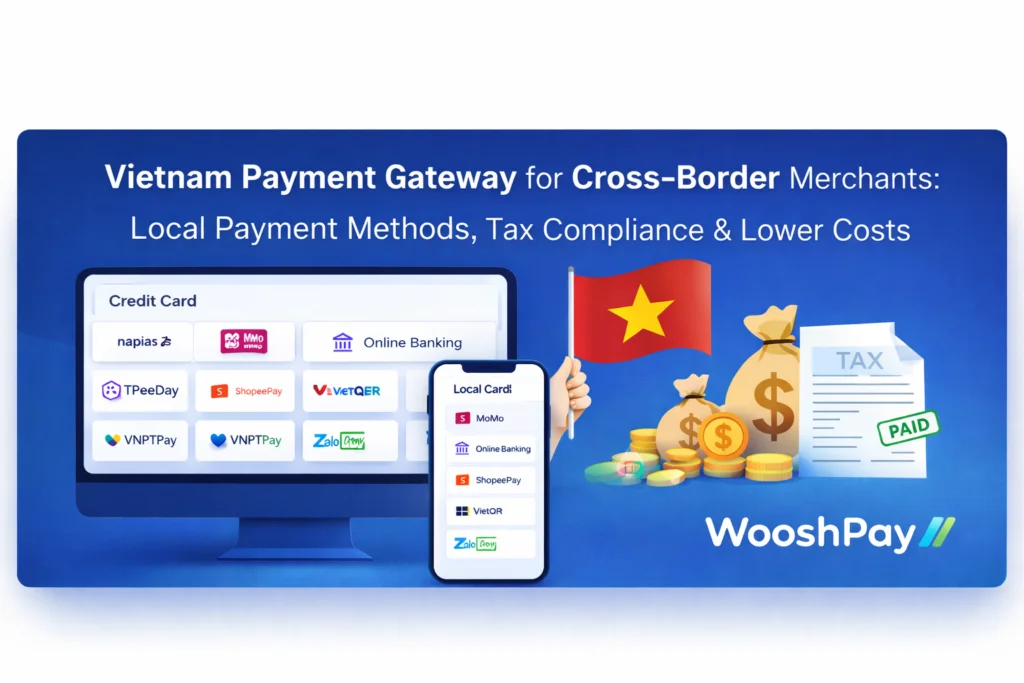
WooshPay helps merchants support both pagamentos com cartão de crédito and a wider set of Vietnam local payment methods, including Local Cards, MoMo, Online Banking, ShopeePay, VietQR, VNPTPay, and ZaloPay. This matters because merchants do not need to choose between international acceptance and local relevance. They can keep card coverage for cross-border needs while also offering the payment methods Vietnamese users are more likely to trust and complete.
That combination improves checkout localization in a practical way. When customers see familiar payment methods, the checkout feels more natural, more credible, and easier to finish. For merchants, that can translate into lower friction, better acceptance, and stronger conversion performance.
Tax Compliance and Cost Optimization
Tax should never be treated as something to bypass. In Vietnam, the direction of regulation is toward more structured administration for e-commerce and digital-platform transactions, especially where payment functions are involved. Merchants therefore need payment infrastructure that supports operational clarity and compliance readiness, not just transaction processing.
Under the WooshPay service model described here, merchants are not separately charged an additional payment-chain tax handling cost, because that component is handled and absorbed by WooshPay within the overall solution. This is not tax avoidance. It is a service structure that centralizes the handling of that part of the payment chain, so merchants do not need to take on a separate standalone burden for it.
In practical terms, that means merchants can reduce fragmented coordination, avoid extra layers of handling cost, and enter Vietnam with a more predictable operating model. The benefit is not “less compliance,” but better cost efficiency under a more organized payment setup.
Why This Matters for Cross-Border Merchants
For cross-border merchants, the Vietnam question is no longer just “Can we accept payments there?” A better question is: can we support local payment habits, keep card acceptance, stay operationally organized, and lower total cost at the same time?
That is where WooshPay stands out. By combining cards with Vietnam local payment methods such as Local Cards, MoMo, Online Banking, ShopeePay, VietQR, VNPTPay, and ZaloPay, and by structuring the service so merchants are not separately billed for that payment-chain tax handling component, WooshPay gives merchants a more practical way to scale in Vietnam.
Perguntas frequentes
Do cross-border merchants need to think about tax when accepting payments in Vietnam?
Yes. Vietnam’s framework for e-commerce and digital-platform tax administration has become more explicit, especially from 1 July 2025. Merchants should treat tax and compliance as part of payment design, not as a separate afterthought.
Is supporting cards enough for Vietnam?
Usually not. Cards are important, but Vietnam’s payment environment is also strongly shaped by QR-based and bank-linked local payment methods such as VietQR, as well as wallets and online banking flows.
Which local payment methods can WooshPay support in Vietnam?
Based on the payment set described here, WooshPay supports Local Cards, MoMo, Online Banking, ShopeePay, VietQR, VNPTPay, and ZaloPay, alongside credit cards.
How does WooshPay help reduce overall costs?
WooshPay helps merchants reduce total cost in two ways: first, by improving local payment coverage and checkout efficiency; second, by handling and absorbing the payment-chain tax handling component within the solution, so merchants are not separately charged that additional cost.